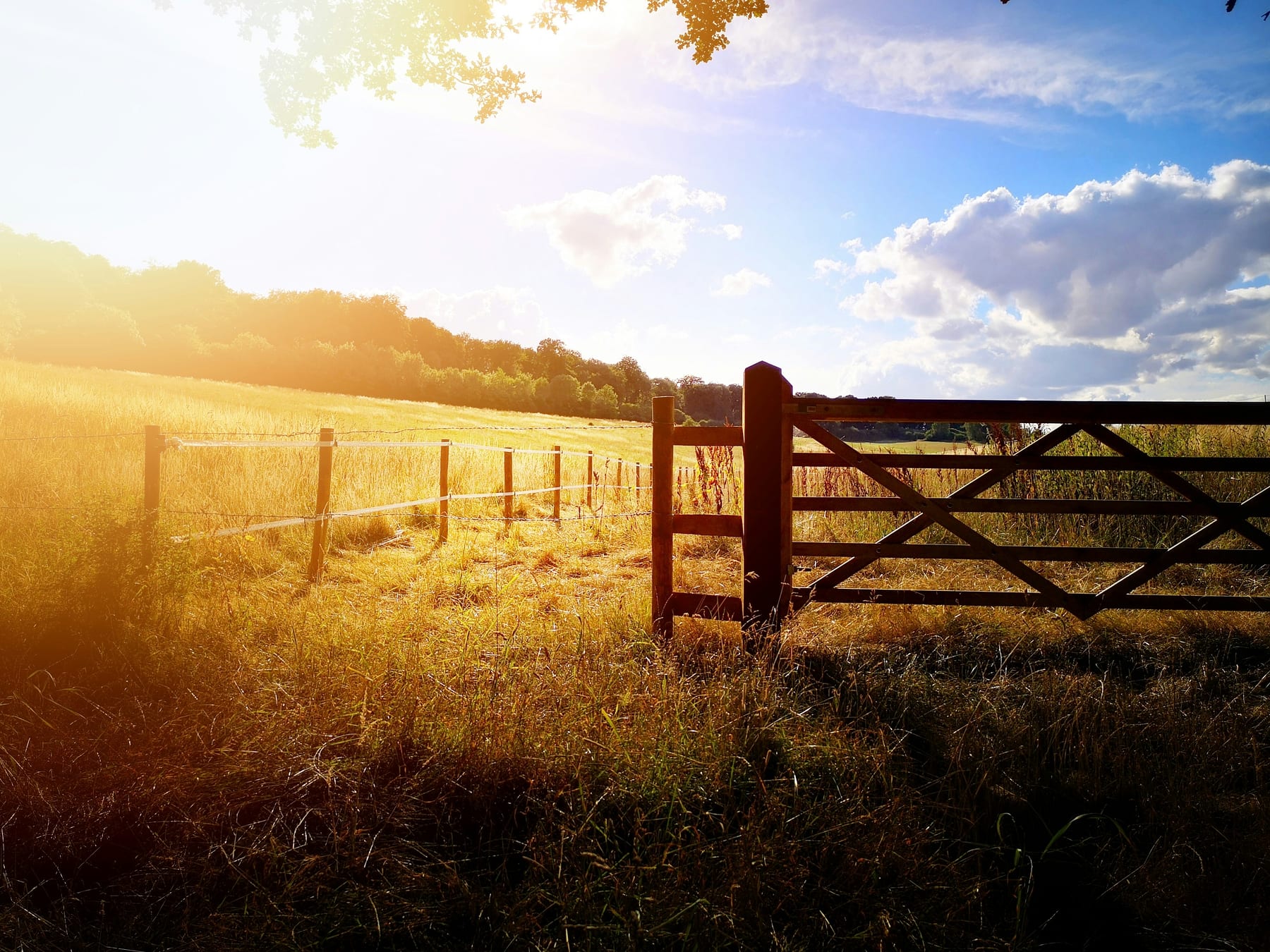
The gate was twenty-five degrees
A month whose theme is never said out loud, and the Monday it got tested in a meadow — five angles, one cardinal, and an eight-year-old's argument with a counterargument she conceded.
Scan to open in WeChat
WeChat has no share link, so point a phone at the code.
At the gate she stopped, put the protractor against the post, and said the number before writing it down. Twenty-five degrees. Then she said it again, differently: that it was smaller than she expected.
That sentence is the whole month, and she got to it on the first Monday.
The theme nobody tells her
The month has a connecting idea running under every subject: the world looks different depending on where you stand and which way you face. Angles in math, compass directions in social studies, the pitch of a roof, the spiral of a shell.
She is not told this. It is the rule of the month. The theme is built into the work and left there, and the only question that ever gets asked out loud is on Friday: these three things you did this week, is there anything the same about them?
The temptation to say it early is constant. Saying it converts a discovery into a fact she has been handed, and she has enough facts. What she is short on is the experience of noticing.
What a field report is
Week one ended in a meadow instead of at the table. One sheet, three tasks, a protractor, and a pencil: hunt five angles and mark each as acute, right or obtuse; observe one living thing, keeping what you saw strictly apart from what you think it means; then argue for something you found, and include the part where someone disagrees with you.
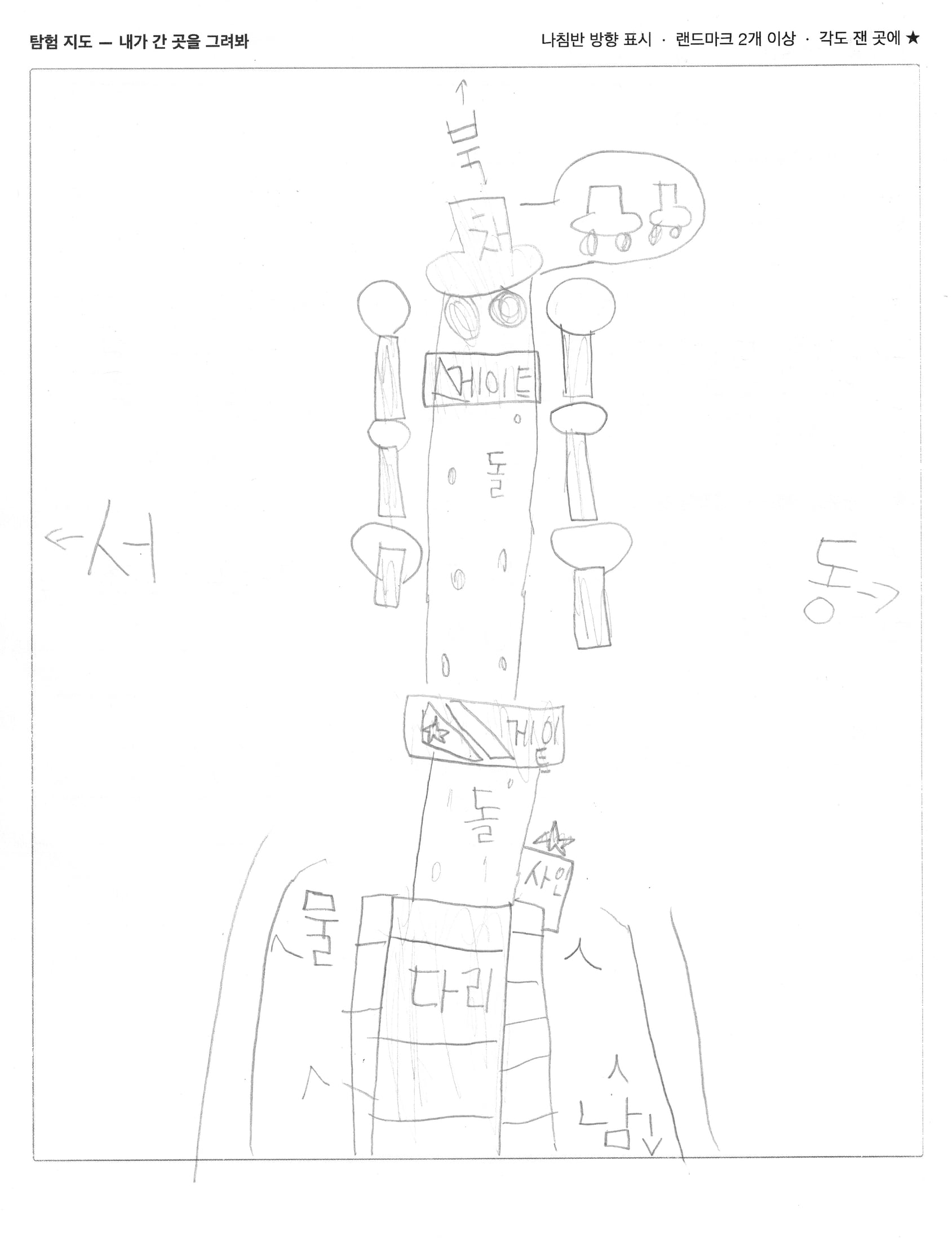
the map, drawn on site — west and east marked, stars where the protractor came out
Five angles, five correct: the gate at 25, a right angle at 90, an obtuse corner at 120, another acute at 50, one more obtuse at 110. The surprising one was the gate, and the sheet asks why it surprised her, which is the part that matters. A number she can look up. A number that contradicts her expectation, she has to account for.
Observation, and the line under it
The bird came at 6:10. She wrote down the tail color and shape, the crest, that it was bigger than a robin, and that it had no black ring around the eye.
Then, below a printed line separating the two, the inferences: that it belonged to the same order as a robin, and might be closely related.
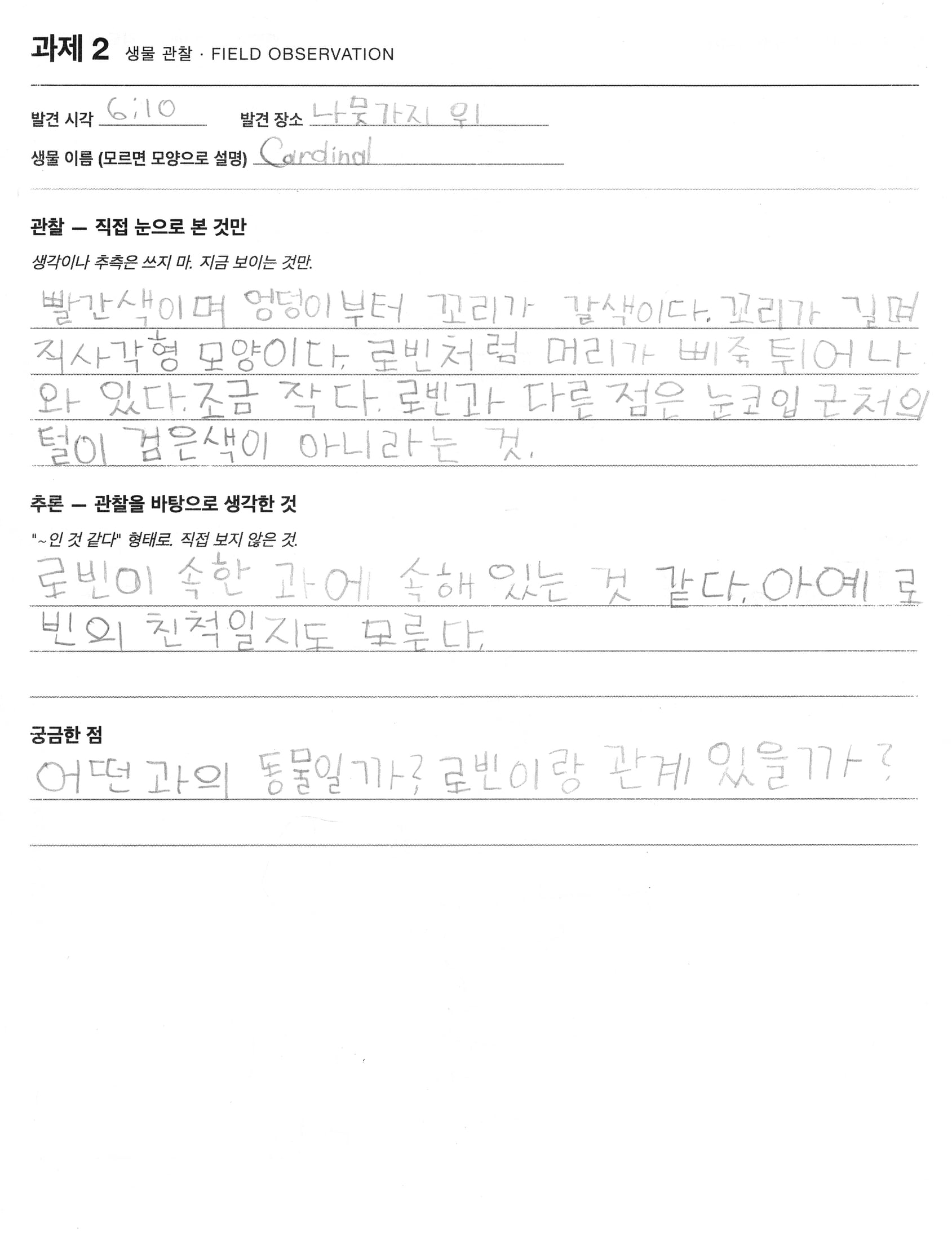
what she saw, above the line; what she thought it meant, below it
The first half is correct. The second half is half right, and the half that is wrong is the interesting one. Cardinals and robins are both passerines, so the order is right. But they sit in different families, and “same order” is a much weaker claim than the resemblance she was feeling. She reasoned soundly from what she could see, and what she could see was not enough to get there.
That went into the notes as the opening for the following week rather than a correction on the day. A wrong inference that was honestly reached is worth more standing than a right one handed over.
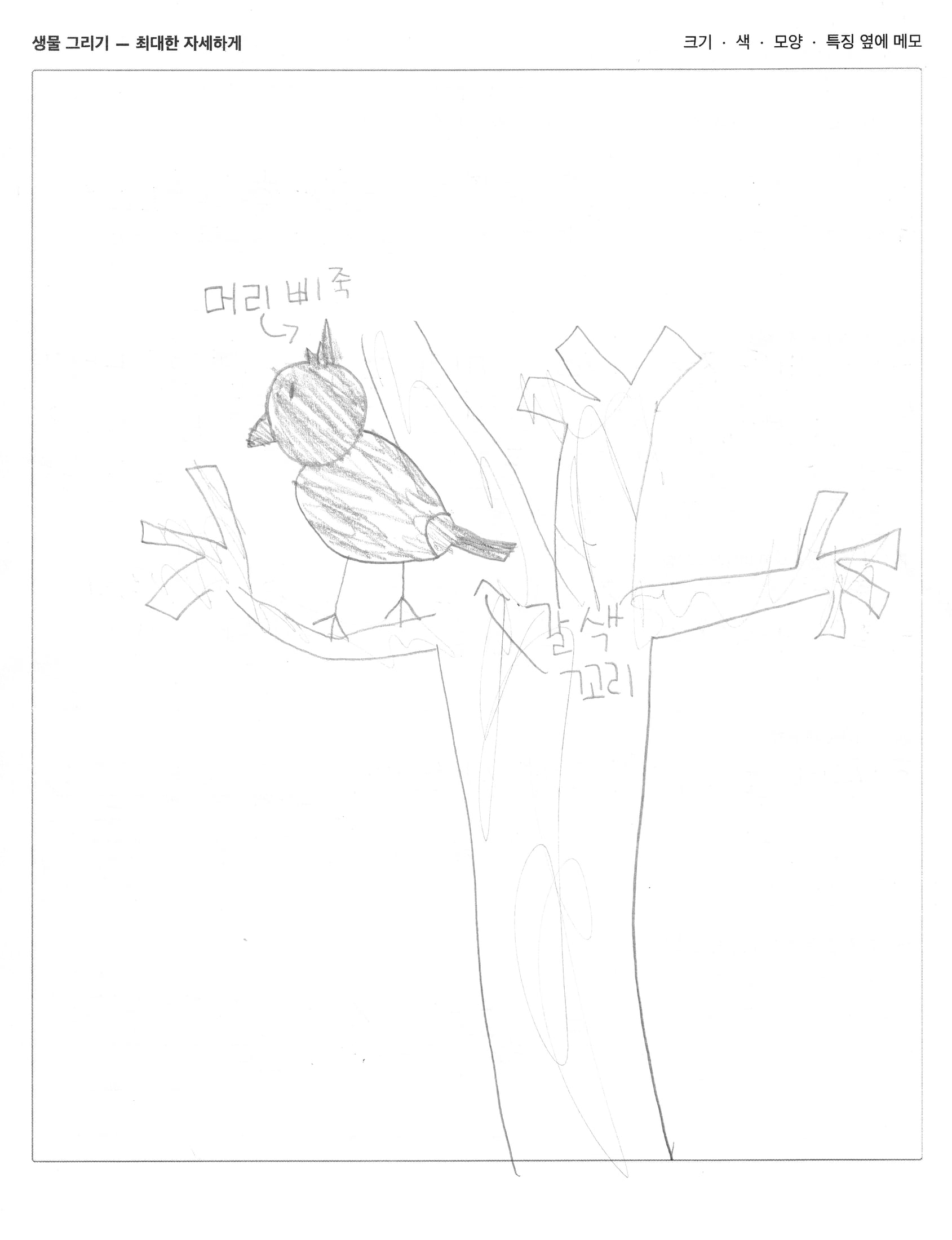
the bird, labeled — the spiky head, the brown tail
The argument
The third task is a formal one: claim, reasons, concede the counterargument, conclude. Written outdoors, in pencil, in Korean, at eight.
Her claim was that cardinals and robins closely resemble each other. Her reasons ran to two: too many shared traits, both quick in flight, even the same spiky head; then both similar in size, and both in the order of songbirds.
Then the turn:
반면, 실제 색, 주식, 부리 모양의 차이 때문에 다른 사람들은 둘이 정말 다르다고 생각할 수 있다.
“On the other hand, because of the differences in their actual color, their diet, and the shape of their beaks, other people might think the two are really quite different.”
She listed the three strongest arguments against her own position, including the one about diet that she had not observed and had to have gone looking for. Then she came back and said the resemblance outweighs them anyway.
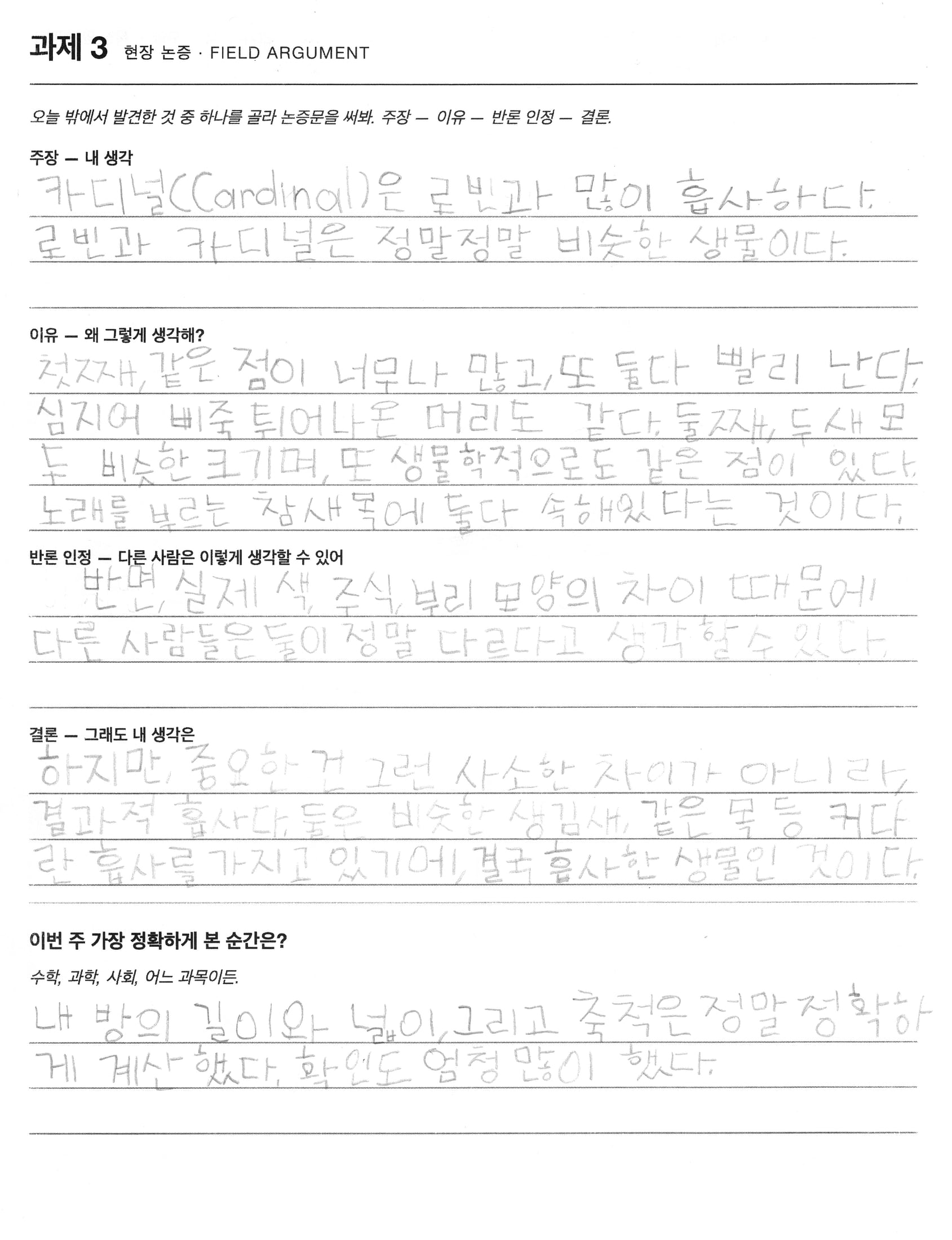
the argument, written in the field
What she said she did best
At the bottom the sheet asks one more thing: what was the moment this week you saw most precisely? Any subject.
She did not write about the bird. She did not write about the gate.
내 방의 길이와 넓이, 그리고 축척은 정말 정확하게 계산했다. 확인도 엄청 많이 했다.
“I calculated my room’s length and width, and the scale, really accurately. I checked a whole lot, too.”
The room-to-scale drawing was Thursday’s work, and the least dramatic thing she did all week. It is also the only one she brought up unprompted, and what she was proud of in it was not the drawing. It was the checking.
That is the habit this whole year is built to close. She is quick, and quickness has been costing her points on work she knows how to do. Nobody asked her to value the checking. She was asked what she saw precisely, and she answered by naming the thing she verified most.
What we did not do
There was no quiz on angle types. There was no vocabulary list. The theme was not named on Monday, or Wednesday, or in the meadow.
On Friday she was asked whether the angles, the snail, and the map had anything in common. She got there.